Introduction
In today’s digital age, artificial intelligence (AI) has become a driving force behind innovation across various industries. From personalized recommendations on streaming platforms to advanced healthcare diagnostics, AI is transforming the way we interact with technology. Building an AI app might seem daunting at first, but with the right approach and tools, anyone can embark on this exciting journey. This article provides a step-by-step guide on how to build an AI app, covering essential concepts, tools, and techniques.
Understanding Artificial Intelligence
Before diving into the development process, it’s crucial to understand what AI is and how it works. Artificial intelligence refers to the simulation of human intelligence processes by machines, primarily through the use of algorithms and data. Machine learning, a subset of AI, enables systems to learn from data without being explicitly programmed. Deep learning, another subset, involves training artificial neural networks on large datasets to make predictions or decisions.
Identifying the Purpose and Use Case
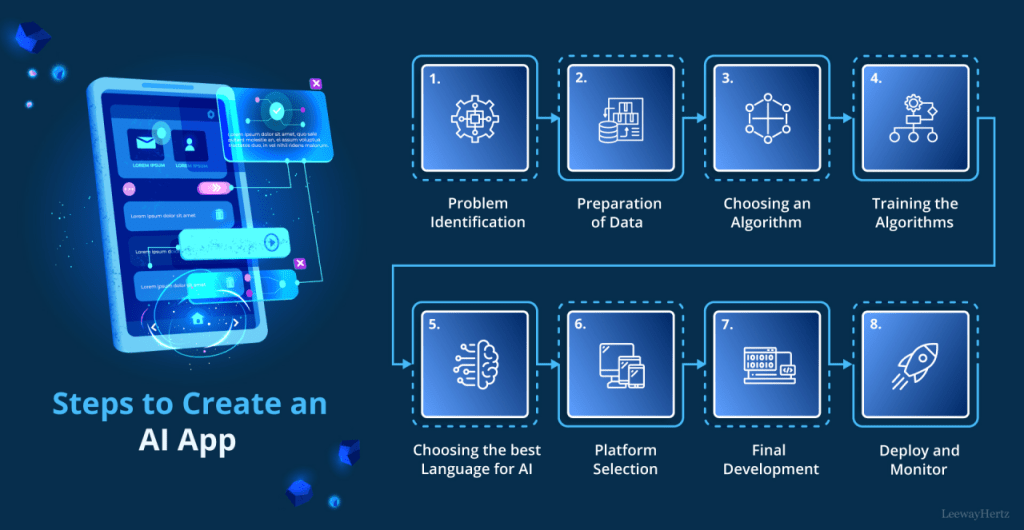
The first step in build an AI app is to clearly define its purpose and use case. Whether it’s automating tasks, enhancing user experience, or solving complex problems, identifying the specific goals of the app is essential. Conduct market research to understand user needs and preferences, and identify areas where AI can add value.
Choosing the Right Development Tools and Frameworks
Selecting the appropriate development tools and frameworks is crucial for building an AI app efficiently. Popular AI frameworks such as TensorFlow, PyTorch, and scikit-learn provide robust libraries and tools for developing machine learning models. For deep learning projects, frameworks like Keras and TensorFlow offer high-level APIs for building neural networks. Additionally, platforms like Google Cloud AI Platform and Amazon SageMaker provide managed services for training and deploying machine learning models.
Data Collection and Preprocessing
High-quality data is the cornerstone of any successful AI application. Collect relevant datasets that align with the app’s objectives and ensure they are clean, labeled, and representative of the target domain. Preprocess the data by removing noise, handling missing values, and standardizing features to improve model performance. Data augmentation techniques such as rotation, flipping, and cropping can also help increase the diversity of the training dataset.
Model Development and Training
Once the data is prepared, it’s time to develop and train the AI models. Depending on the use case, choose the appropriate algorithm and architecture for the task at hand. For classification problems, algorithms like logistic regression, decision trees, and neural networks are commonly used. Regression tasks may require algorithms such as linear regression or support vector machines. Experiment with different models, hyperparameters, and optimization techniques to improve performance.
Evaluation and Validation
After training the models, it’s essential to evaluate their performance using validation datasets. Metrics such as accuracy, precision, recall, and F1-score provide insights into the model’s effectiveness. Conduct thorough testing to identify potential issues such as overfitting or underfitting and fine-tune the models accordingly. Cross-validation techniques such as k-fold validation can help assess the model’s generalization capabilities.
Integration and Deployment
Once the models are trained and validated, integrate them into the app’s architecture for deployment. Choose deployment options based on factors like scalability, latency requirements, and infrastructure constraints. Containerization tools like Docker facilitate the packaging of AI models into lightweight, portable containers. Deploy the app on cloud platforms like AWS, Google Cloud, or Microsoft Azure for scalability and accessibility.
Monitoring and Maintenance
Building an AI app is not a one-time endeavor; it requires ongoing monitoring and maintenance to ensure optimal performance. Implement monitoring tools to track key metrics such as model accuracy, inference time, and resource utilization. Regularly update the models with new data and retrain them to adapt to changing patterns and trends. Address any issues or feedback from users promptly to maintain the app’s reliability and effectiveness.
Conclusion
In conclusion, building an AI app requires careful planning, execution, and iteration. By following the steps outlined in this guide and leveraging the right tools and techniques, developers can create powerful AI applications that deliver value to users and businesses alike. Whether it’s enhancing productivity, improving decision-making, or revolutionizing entire industries, AI has the potential to drive innovation and transformation on a global scale. So, roll up your sleeves, dive into the world of artificial intelligence, and start building your own AI app today!
 Tech Business
Leave a comment