Introduction
In the realm of artificial intelligence (AI), generative models have emerged as a groundbreaking technology, offering remarkable capabilities in creating and synthesizing data. Through complex algorithms and neural networks, generative AI has the ability to generate new content, images, text, and even human-like interactions. This transformative technology is revolutionizing various industries, paving the way for innovative applications and use cases that were once considered beyond the realm of possibility.
Understanding Generative AI
Generative AI refers to a class of machine learning algorithms that are designed to generate new data samples that are similar to those in the training data. Unlike traditional AI models that are trained to recognize patterns and make predictions, generative AI models have the ability to create entirely new data based on the patterns they have learned. This is achieved through techniques such as generative adversarial networks (GANs), variational autoencoders (VAEs), and transformer architectures, among others.
Use Cases in Art and Design
Generative AI is making significant waves in the fields of art and design, enabling artists and creators to explore new realms of creativity. One notable application is the generation of art and imagery. Artists can leverage generative AI algorithms to produce unique and captivating artworks, ranging from paintings and sculptures to digital illustrations and multimedia installations. These algorithms can also assist designers in generating new concepts and prototypes for products, architecture, and fashion, pushing the boundaries of innovation in creative industries.
Applications in Content Generation
Generative AI is revolutionizing content creation by automating the process of generating text, audio, and video content. Content creators can use generative models to produce articles, blog posts, and social media content at scale, thereby streamlining their workflow and reaching a wider audience. Additionally, generative AI can be employed to generate personalized recommendations and summaries, enhancing the user experience across various platforms.
Advancements in Healthcare
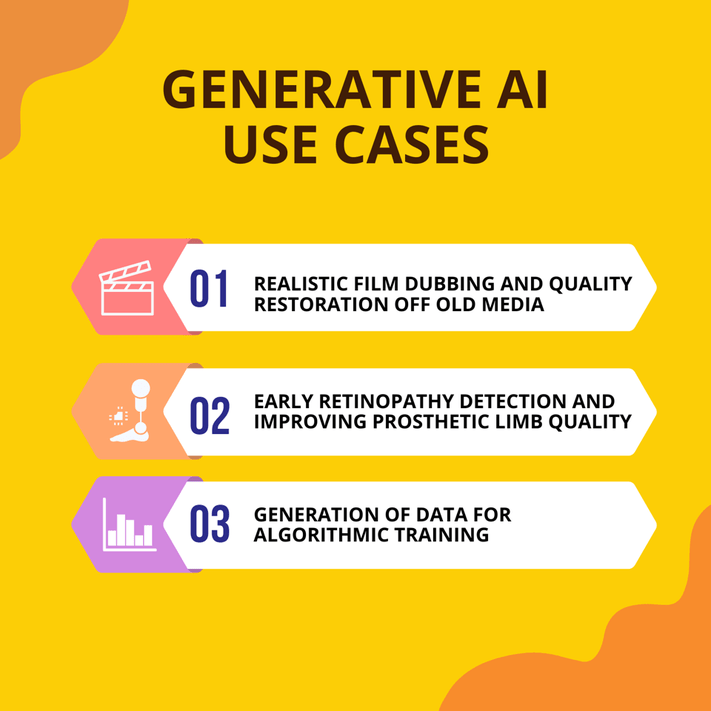
In the healthcare sector, generative AI is driving advancements in medical imaging, drug discovery, and personalized medicine. By analyzing vast amounts of medical data, generative models can assist radiologists in detecting anomalies and diagnosing diseases with greater accuracy. Furthermore, generative AI algorithms are being used to design novel drug molecules and predict their efficacy, accelerating the drug discovery process and reducing the time and cost associated with bringing new treatments to market.
Enhancing Virtual Environments
Generative AI is playing a pivotal role in the development of virtual environments and simulations. By generating realistic textures, landscapes, and characters, generative models can create immersive virtual worlds for gaming, training, and entertainment purposes. Moreover, generative AI enables the generation of lifelike avatars and conversational agents, enhancing the realism and interactivity of virtual environments.
Applications in Finance and Trading
In the financial industry, generative AI is being utilized for a wide range of applications, including fraud detection, risk assessment, and algorithmic trading. By analyzing historical data and market trends, generative models can identify patterns and anomalies that may indicate fraudulent activities or market inefficiencies. Additionally, generative AI algorithms can generate synthetic financial data for training predictive models, enabling financial institutions to make more informed decisions and mitigate risks.
Challenges and Ethical Considerations
While generative AI holds immense potential, it also presents various challenges and ethical considerations. One of the primary concerns is the potential misuse of generative models for creating deepfakes and spreading misinformation. Moreover, there are concerns about bias and fairness in the data used to train generative AI algorithms, which could lead to unintended consequences and reinforce existing societal inequalities. Addressing these challenges will require a concerted effort from researchers, policymakers, and industry stakeholders to ensure the responsible development and deployment of generative AI technologies.
Conclusion
Generative AI represents a paradigm shift in artificial intelligence, offering unprecedented capabilities in generating new content, insights, and experiences. From art and design to healthcare and finance, the applications of generative AI are vast and diverse, promising to reshape industries and transform the way we live, work, and interact with technology. However, as we harness the power of generative AI, it is imperative to tread carefully and address the associated challenges and ethical considerations to ensure a future where AI serves as a force for good.
 Tech Business
Leave a comment