Building a generative AI solution can seem like a daunting task, but with the right approach and tools, it’s entirely achievable. In this guide, we’ll explore how to build a generative AI solution, breaking down the process into clear and manageable steps. This article is designed to be straightforward and SEO-optimized, ensuring that you get practical advice on how to implement a successful generative AI project.
Understanding Generative AI
What is Generative AI?
Generative AI refers to artificial intelligence systems that can create new content based on patterns and data they have been trained on. Unlike traditional AI, which focuses on classification or prediction, generative AI models generate novel outputs such as images, text, or music. To effectively build a generative AI solution, you need to grasp this fundamental concept.
Step 1: Define Your Objectives
Identify the Problem You Want to Solve
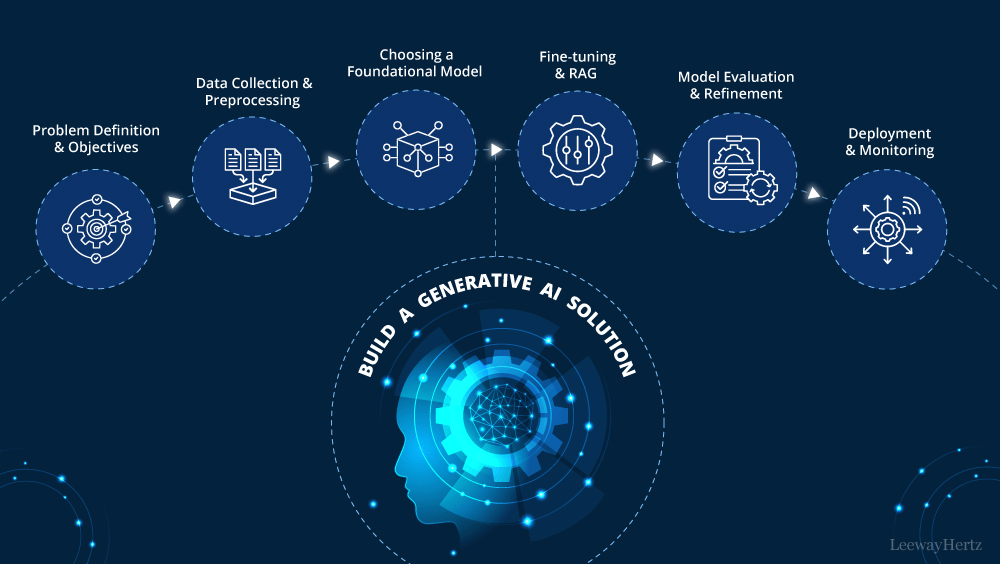
Before diving into the technical aspects, it’s crucial to define what you want to achieve with your generative AI solution. Are you aiming to create realistic images, generate human-like text, or design unique product prototypes? Clearly outlining your objectives will guide your choice of tools and methods.
Set Measurable Goals
Setting measurable goals helps in evaluating the effectiveness of your generative AI solution. For instance, if you are building a text generation model, your goals might include metrics like coherence, relevance, and fluency of the generated text.
Step 2: Collect and Prepare Data
Gather Relevant Data
Data is the backbone of any AI solution. To build a robust generative AI model, you need a substantial amount of high-quality data related to your problem domain. For example, if you’re developing a text generator, you’ll need a large corpus of text data.
Data Cleaning and Preprocessing
Raw data often needs cleaning and preprocessing to be useful for training. This step involves removing noise, handling missing values, and normalizing the data. Proper preprocessing ensures that your generative AI model learns effectively.
Step 3: Choose the Right Model
Explore Available Models
Different types of generative AI models serve various purposes. For text generation, models like GPT (Generative Pre-trained Transformer) are popular. For image generation, GANs (Generative Adversarial Networks) are commonly used. Research and select a model that aligns with your objectives.
Consider Model Complexity
The complexity of your model should match your project’s needs. Simple models might work for basic tasks, while more complex models are necessary for sophisticated applications. Balancing complexity with performance is key to building a successful generative AI solution.
Step 4: Train Your Model
Set Up Training Environment
Training a generative AI model requires a suitable environment with adequate computational resources. High-performance GPUs or TPUs are often necessary for efficient training, especially for complex models.
Monitor Training Progress
During training, regularly monitor the model’s performance to ensure it’s learning correctly. This includes tracking loss functions, evaluating generated outputs, and adjusting hyperparameters as needed. Proper monitoring helps in fine-tuning the model to achieve better results.
Step 5: Evaluate and Optimize
Test the Model
Once trained, it’s essential to evaluate your generative AI solution using a separate validation dataset. This helps in assessing how well the model performs on new, unseen data and ensures it generalizes well.
Optimize Performance
Based on evaluation results, you might need to optimize your model. This can involve tuning hyperparameters, adjusting the model architecture, or augmenting the training data. Continuous optimization is crucial for enhancing the quality of the generated outputs.
Step 6: Deploy and Maintain
Deploy the Solution
After finalizing your generative AI model, the next step is deployment. This involves integrating the model into your application or system where it can generate content in real-time. Ensure that the deployment environment is stable and scalable to handle user demands.
Regular Maintenance and Updates
Maintaining your generative AI solution involves monitoring its performance post-deployment, updating it with new data, and making improvements based on user feedback. Regular maintenance helps in keeping the model relevant and effective over time.
Conclusion
Building a generative AI solution involves several key steps, from defining your objectives to deploying and maintaining the model. By following this guide on how to build a generative AI solution, you can systematically approach each phase of the process. Remember, the success of a generative AI project depends on a clear understanding of your goals, the quality of your data, and the effectiveness of your chosen model. With careful planning and execution, you can create a generative AI solution that meets your needs and delivers valuable outcomes.
 Tech Business
Leave a comment