Generative AI has revolutionized various industries by creating new content, enhancing user experiences, and automating complex processes. If you’re looking to harness this technology, it’s crucial to understand the process of building a generative AI solution. This guide will walk you through the necessary steps to create a generative AI solution that is both effective and efficient.
Understanding Generative AI
Before diving into how to build a generative AI solution, it’s essential to grasp the concept of generative AI. Generative AI refers to algorithms that can generate new content, such as text, images, or music, based on the data they have been trained on. These algorithms are capable of understanding patterns and creating outputs that mimic human creativity.
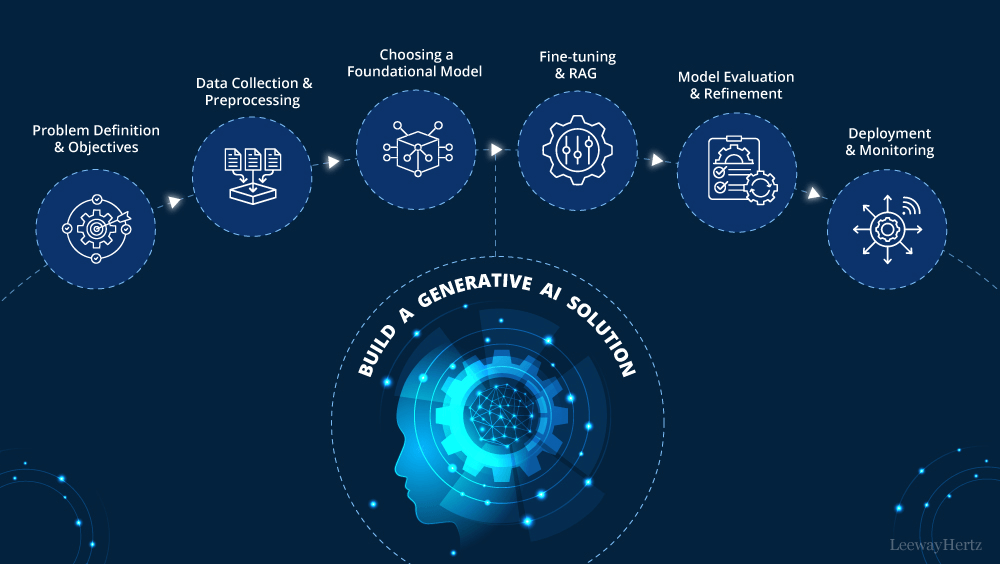
Step 1: Define Your Objectives
The first step in how to build a generative AI solution is to clearly define your objectives. What do you want your generative AI to achieve? Are you looking to generate realistic images, write human-like text, or create original music? Defining your goals will help you choose the right tools and approaches for your project.
Step 2: Gather and Prepare Data
Data is the backbone of any AI solution. To build a generative AI solution, you need a large and diverse dataset relevant to your objectives. For example, if you want to generate text, you need a substantial corpus of text data. If your goal is to create images, you need a vast collection of images. Ensure your data is clean, well-labeled, and representative of the outcomes you desire.
Step 3: Choose the Right Model
Selecting the right model is crucial in how to build a generative AI solution. Some popular models for generative AI include:
- Generative Adversarial Networks (GANs): Ideal for generating images and other visual content.
- Variational Autoencoders (VAEs): Useful for creating images and data compression.
- Transformers: Excellent for generating text and language-related tasks.
Each model has its strengths and weaknesses, so choose one that aligns with your objectives and data.
Step 4: Train Your Model
Training your model is a critical step in building a generative AI solution. This involves feeding your data into the model and allowing it to learn the patterns and features of the data. Training can be computationally intensive and time-consuming, requiring powerful hardware and optimized algorithms. Be prepared to iterate and fine-tune your model to achieve the best results.
Step 5: Evaluate and Fine-Tune
After training your model, it’s essential to evaluate its performance. Assess the quality of the generated outputs and compare them to your objectives. Fine-tuning may involve adjusting the model’s parameters, using different training techniques, or incorporating more data. Continuous evaluation and refinement are key to achieving a high-quality generative AI solution.
Step 6: Deploy Your Solution
Once your model is trained and fine-tuned, it’s time to deploy your generative AI solution. This involves integrating the model into your application or platform, ensuring it operates smoothly and efficiently. Consider the scalability and performance of your solution, as well as any security and privacy concerns.
Step 7: Monitor and Improve
Building a generative AI solution doesn’t end with deployment. Continuous monitoring and improvement are essential to maintaining and enhancing your solution. Keep track of its performance, gather user feedback, and stay updated with the latest advancements in AI technology. Regular updates and improvements will ensure your generative AI solution remains effective and competitive.
Common Challenges and Solutions
When learning how to build a generative AI solution, you’ll likely encounter several challenges. Here are some common issues and their solutions:
- Data Quality: Ensure your data is clean, well-labeled, and diverse to improve model performance.
- Computational Resources: Invest in powerful hardware or use cloud-based solutions to handle the intensive computational requirements.
- Model Overfitting: Use techniques like regularization and dropout to prevent your model from overfitting the training data.
- Evaluation Metrics: Choose appropriate metrics to evaluate your model’s performance, such as accuracy, precision, recall, and F1 score.
Conclusion
Building a generative AI solution can be a complex but rewarding process. By following these steps—defining your objectives, gathering and preparing data, choosing the right model, training, evaluating, deploying, and continuously improving—you can create a powerful generative AI solution tailored to your needs. Remember, the key to success lies in understanding your goals, selecting the right tools, and being prepared to iterate and refine your approach. Embrace the journey of how to build a generative AI solution and unlock the potential of this transformative technology.
 Tech Business
Leave a comment