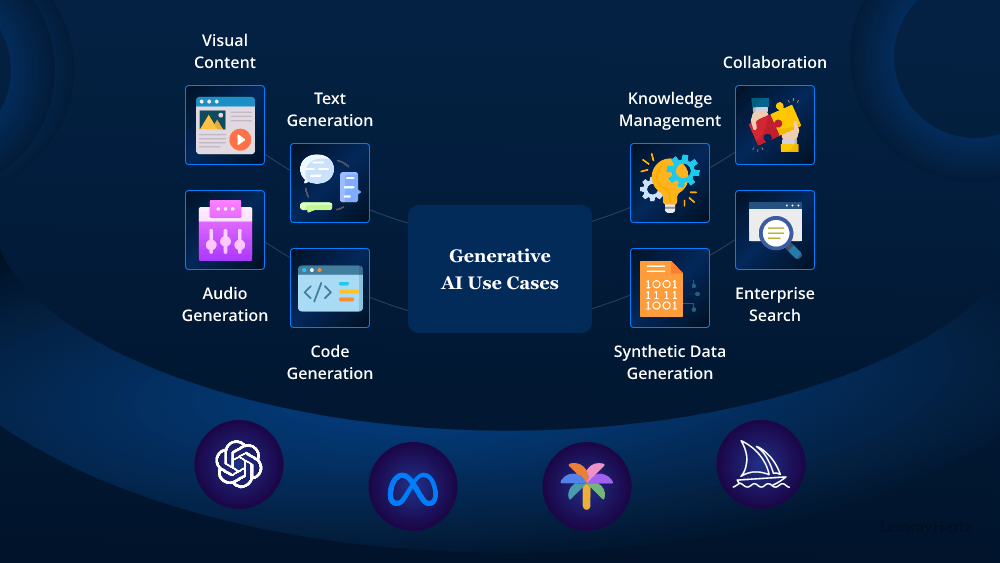
Generative AI is transforming various industries with its ability to create content, improve processes, and offer innovative solutions. In this article, we will delve into the diverse Generative AI use cases, applications, solutions, and the steps involved in its implementation.
Understanding Generative AI
Generative AI is a subset of artificial intelligence focused on creating new content by learning patterns from existing data. Unlike traditional AI, which relies on predefined rules, Generative AI can produce text, images, music, and more. This ability to generate new content makes it highly valuable across multiple fields.
Generative AI Use Cases
Generative AI is revolutionizing various sectors by offering unique use cases that enhance efficiency and creativity.
Content Creation
One of the most popular Generative AI use cases is content creation. AI can generate articles, blogs, and even poetry, saving time and effort for writers. Platforms like OpenAI’s GPT-3 can produce coherent and contextually relevant text, making it a powerful tool for content marketers and writers.
Art and Design
In the world of art and design, Generative AI is making waves. Artists use AI to create original artwork, generate design concepts, and even produce animations. Tools like DeepArt and Runway ML enable artists to push the boundaries of creativity.
Music Composition
Generative AI applications in music composition are gaining traction. AI models can compose original music, suggest chord progressions, and even create entire songs. This technology is particularly beneficial for musicians looking to experiment with new styles and genres.
Healthcare
Generative AI is also making significant strides in healthcare. It can generate synthetic medical data to train models, create personalized treatment plans, and even design new drugs. These Generative AI solutions are helping to advance medical research and improve patient care.
Generative AI Applications
Generative AI applications span across various domains, showcasing its versatility and impact.
Marketing and Advertising
In marketing and advertising, Generative AI is used to create personalized ad content, generate customer insights, and optimize campaigns. By analyzing consumer behavior, AI can produce targeted content that resonates with specific audiences, enhancing engagement and conversion rates.
Gaming
The gaming industry is leveraging Generative AI to create dynamic and immersive gaming experiences. AI can generate game levels, characters, and storylines, providing players with unique and personalized experiences. This application of Generative AI is transforming game development by reducing production time and costs.
Finance
In finance, Generative AI applications include fraud detection, algorithmic trading, and risk management. AI can generate realistic financial scenarios to test strategies, identify anomalies in transactions, and provide insights for making informed decisions. These applications are enhancing the efficiency and security of financial operations.
Education
Generative AI is also being applied in education to develop personalized learning experiences. AI can generate customized study materials, create interactive lessons, and even offer tutoring services. This technology is helping to make education more accessible and tailored to individual learning needs.
Generative AI Solutions
Generative AI solutions are designed to address specific challenges and provide innovative approaches to problem-solving.
Data Augmentation
One of the key Generative AI solutions is data augmentation. AI can generate synthetic data to supplement existing datasets, improving the performance of machine learning models. This is particularly useful in scenarios where data is scarce or imbalanced.
Virtual Assistants
Generative AI powers virtual assistants capable of carrying out complex conversations and tasks. These AI-driven assistants can generate natural language responses, assist with scheduling, and provide customer support, enhancing productivity and user experience.
Drug Discovery
In drug discovery, Generative AI solutions are accelerating the identification and development of new drugs. AI models can generate potential drug candidates, predict their interactions, and optimize their chemical structures, significantly reducing the time and cost involved in bringing new drugs to market.
Generative AI Implementation
Implementing Generative AI involves several steps to ensure successful deployment and integration into existing systems.
Data Collection and Preparation
The first step in Generative AI implementation is data collection and preparation. High-quality, diverse datasets are crucial for training AI models. Data must be cleaned, labeled, and preprocessed to ensure accuracy and relevance.
Model Selection and Training
Choosing the right model is essential for effective Generative AI implementation. Various models, such as GPT, GANs, and VAEs, are available depending on the use case. Training the model involves feeding it large amounts of data and fine-tuning it to achieve the desired output.
Integration and Deployment
Once trained, the AI model needs to be integrated into the desired application or system. This involves developing APIs, creating user interfaces, and ensuring compatibility with existing software. Deployment should be carefully monitored to ensure optimal performance and address any issues that arise.
Monitoring and Maintenance
Post-deployment, continuous monitoring and maintenance are essential to ensure the Generative AI solution remains effective. Regular updates, retraining with new data, and addressing any biases or inaccuracies are necessary to maintain performance and reliability.
Conclusion
Generative AI is a powerful technology with numerous use cases and applications across various industries. From content creation to healthcare, Generative AI solutions are driving innovation and efficiency. Implementing Generative AI involves careful planning, data preparation, and ongoing maintenance. As this technology continues to evolve, its potential to transform industries and improve our daily lives will only grow.
 Tech Business
Leave a comment