Diffusion models are a fascinating branch of machine learning, particularly known for their ability to generate highly realistic images, videos, and other types of data. If you’re interested in exploring how to train a diffusion model, this guide will walk you through the process in a simple and accessible way.
Understanding Diffusion Models
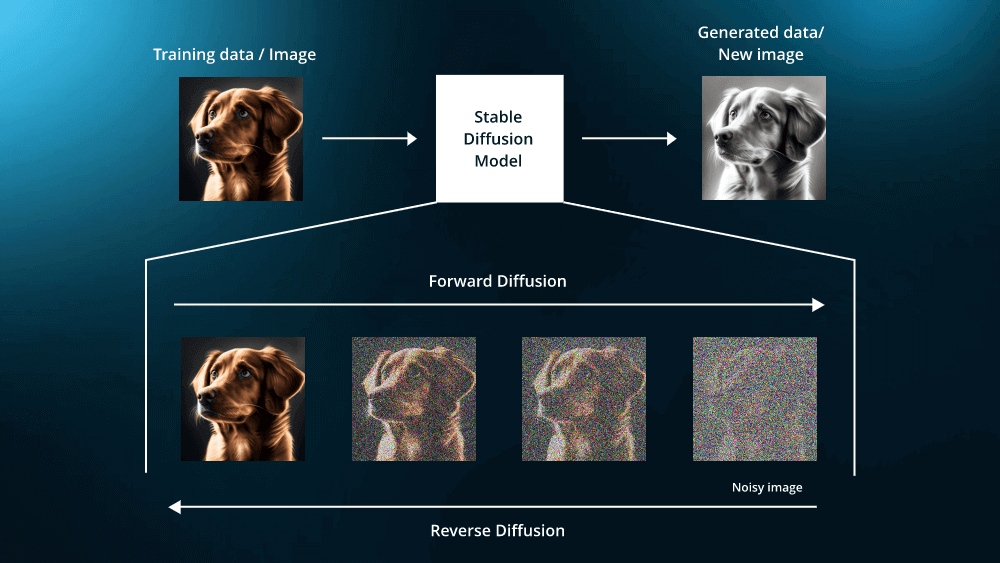
Before you start learning how to train a diffusion model, it’s essential to understand the core concept behind them. Diffusion models operate by simulating a gradual noise addition process to data, which is then learned to be reversed by the model. Essentially, the model starts with pure noise and attempts to generate a realistic data sample through a series of learned steps. These models are particularly powerful in tasks such as image generation, where the goal is to produce data that closely mimics the original input.
Step 1: Setting Up the Environment
The first step in how to train a diffusion model involves setting up a suitable environment. Since diffusion models typically require significant computational resources, especially when dealing with large datasets, it’s important to have access to a powerful GPU.
- Selecting a Framework: Choose a deep learning framework like TensorFlow or PyTorch, as these are widely supported and offer the necessary tools for building and training diffusion models.
- Data Collection: The dataset is a crucial element in training a diffusion model. Depending on your specific application—whether it’s image generation, text synthesis, or something else—you should select a dataset that is large enough and representative of the task at hand. Popular choices include CIFAR-10 for images or text-based datasets like Wikipedia for language models.
Step 2: Data Preprocessing
When discussing how to train a diffusion model, data preprocessing cannot be overlooked. The quality of the input data significantly influences the model’s performance.
- Normalization: Most diffusion models require data to be normalized, ensuring that all input data is on a similar scale. This can involve scaling pixel values in images or normalizing text vectors.
- Data Augmentation: To improve the robustness of the model, data augmentation techniques such as flipping, cropping, or adding noise can be applied. These techniques help the model generalize better by exposing it to a wider variety of input scenarios during training.
Step 3: Model Architecture
The architecture of your diffusion model is the blueprint that determines how it processes data and learns from it. Understanding how to train a diffusion model also involves knowing which architectural components are crucial.
- Base Model Selection: Start with a base model, often a variant of convolutional neural networks (CNNs) for image tasks or transformers for text tasks. This model will be the foundation upon which the diffusion process is built.
- Noise Schedule: The noise schedule is a critical part of diffusion models. It defines how noise is added to the data during the training process. A well-designed noise schedule gradually increases the noise, allowing the model to learn to denoise progressively.
- Reverse Process: The reverse process is where the magic happens in diffusion models. This process involves training the model to reverse the noise addition, step by step, to recover the original data. This is typically done through multiple iterations, where the model is fine-tuned to improve its denoising capabilities.
Step 4: Training the Diffusion Model
The training process is the heart of understanding how to train a diffusion model. During training, the model learns to reverse the diffusion process effectively, generating data that is indistinguishable from the original input.
- Loss Function: The loss function measures how well the model is performing during training. For diffusion models, the loss function typically compares the generated data to the original data, guiding the model to improve its outputs.
- Optimization: Optimization techniques like gradient descent are used to minimize the loss function. During this process, the model’s parameters are adjusted iteratively, improving its ability to reverse the noise addition process.
- Training Time: Depending on the complexity of the model and the size of the dataset, training can take anywhere from a few hours to several days. It’s crucial to monitor the training process to ensure that the model is learning effectively and not overfitting to the training data.
Step 5: Evaluation and Fine-Tuning
After training, the next step in how to train a diffusion model is evaluating its performance. This involves testing the model on unseen data and adjusting it to correct any errors.
- Evaluation Metrics: Use metrics such as mean squared error (MSE) or structural similarity index (SSIM) to assess the quality of the generated data. These metrics help determine how closely the generated samples match the original data.
- Fine-Tuning: Based on the evaluation results, fine-tuning might be necessary. This could involve adjusting the model’s parameters, tweaking the noise schedule, or even re-training the model with additional data.
Conclusion: Mastering How to Train a Diffusion Model
Learning how to train a diffusion model is a complex but rewarding process. By following these steps—setting up the environment, preprocessing data, designing the model architecture, training, and fine-tuning—you can create a model capable of generating highly realistic data. Whether you’re working with images, text, or other types of data, mastering diffusion models opens up exciting possibilities in the world of machine learning.
 Tech Business
Leave a comment