Introduction
In the digital age, organizations are generating massive amounts of data every second. From financial transactions to network traffic, this data holds valuable insights that can drive decisions and optimize operations. However, detecting anomalies within this vast sea of information is a challenging task. Traditional methods often fall short in identifying unusual patterns or behaviors, making it difficult to address issues proactively. This is where AI in anomaly detection comes into play, offering a powerful solution to enhance accuracy, efficiency, and scalability in monitoring and analyzing data.
Understanding Anomaly Detection
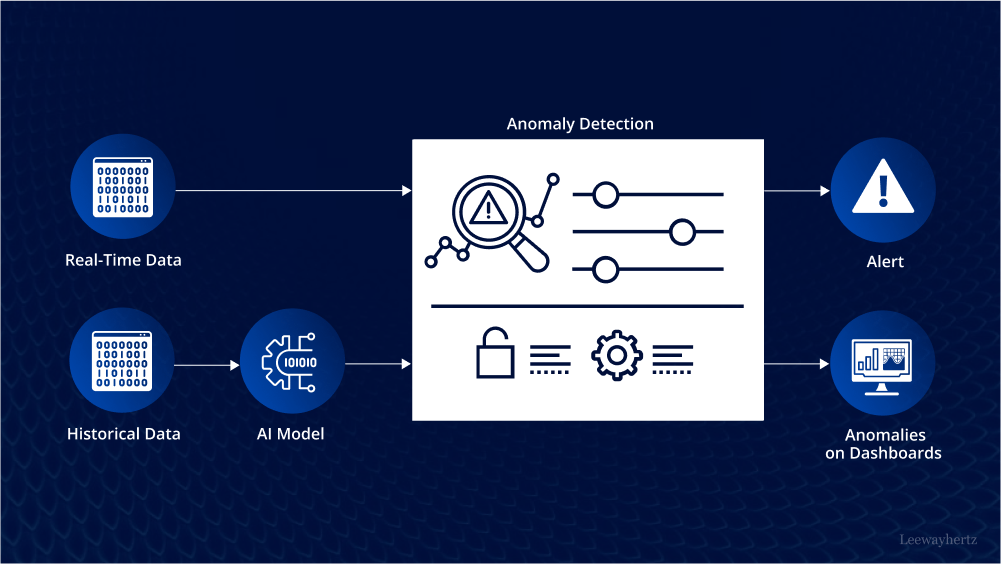
Anomaly detection refers to the process of identifying data points, events, or patterns that deviate significantly from the norm. These anomalies can indicate potential problems, such as fraudulent activities, system failures, or security breaches. Detecting these irregularities early is crucial for preventing more significant issues down the line.
Traditional anomaly detection methods often rely on predefined rules or statistical models, which may not be effective in handling complex, high-dimensional data. These methods can struggle to adapt to evolving patterns or identify subtle deviations, leading to missed anomalies or false positives. This is where AI in anomaly detection excels, leveraging machine learning and deep learning algorithms to automatically learn from data and identify even the most elusive outliers.
The Role of AI in Anomaly Detection
AI in anomaly detection brings a new level of sophistication to the process by automating and enhancing the detection capabilities. Machine learning algorithms, such as clustering, classification, and neural networks, can analyze vast datasets, learn from historical data, and identify patterns that traditional methods might overlook. By using AI, organizations can achieve more accurate and timely anomaly detection, ultimately improving decision-making and mitigating risks.
One of the key advantages of AI in anomaly detection is its ability to handle large-scale, high-dimensional data. As data grows in volume and complexity, manual monitoring becomes impractical. AI-driven models can process and analyze this data in real-time, identifying anomalies as they occur. This real-time detection is crucial in applications like cybersecurity, where detecting a threat within seconds can make all the difference in preventing a breach.
Applications of AI in Anomaly Detection
The applications of AI in anomaly detection are vast and span across various industries. Here are a few key areas where AI-driven anomaly detection is making a significant impact:
- Cybersecurity: In cybersecurity, detecting unusual patterns in network traffic, user behavior, or system logs is essential for identifying potential threats. AI in anomaly detection enables security systems to quickly identify and respond to these threats, reducing the risk of data breaches and cyberattacks.
- Finance: Financial institutions use AI in anomaly detection to monitor transactions for signs of fraud or money laundering. By analyzing transaction patterns and identifying irregularities, AI can help prevent fraudulent activities and ensure compliance with regulations.
- Manufacturing: In manufacturing, AI-driven anomaly detection can monitor equipment performance and predict potential failures. This proactive approach helps in reducing downtime, improving efficiency, and preventing costly repairs.
- Healthcare: In healthcare, AI in anomaly detection is used to monitor patient data for signs of deterioration or abnormal conditions. Early detection of anomalies can lead to timely interventions, improving patient outcomes and reducing healthcare costs.
- Retail: Retailers leverage AI to analyze customer behavior and detect unusual purchasing patterns that may indicate fraudulent activity or market trends. This helps in optimizing inventory management and enhancing customer experiences.
Challenges and Future Directions
While AI in anomaly detection offers numerous benefits, it is not without challenges. One significant challenge is the need for high-quality, labeled data to train machine learning models effectively. In many cases, obtaining labeled anomaly data can be difficult, as anomalies are rare by definition. Additionally, there is the risk of false positives, where the system incorrectly flags normal behavior as anomalous, leading to unnecessary alerts or interventions.
To address these challenges, ongoing research is focused on developing more sophisticated AI algorithms that can learn from limited data and improve their accuracy over time. Techniques like semi-supervised learning, transfer learning, and reinforcement learning are being explored to enhance the capabilities of AI in anomaly detection.
Moreover, as AI in anomaly detection continues to evolve, the integration of explainable AI (XAI) is becoming increasingly important. XAI aims to make AI systems more transparent and interpretable, allowing users to understand why a particular anomaly was detected. This transparency is crucial in building trust and ensuring that AI-driven decisions are reliable and actionable.
Conclusion
AI in anomaly detection is revolutionizing the way organizations monitor and analyze their data. By leveraging advanced machine learning algorithms, AI can identify even the most subtle anomalies in real-time, providing a proactive approach to risk management. From cybersecurity to healthcare, the applications of AI-driven anomaly detection are vast and continue to expand. While challenges remain, ongoing advancements in AI promise to further enhance the accuracy, efficiency, and scalability of anomaly detection, empowering organizations to make smarter, data-driven decisions.
 Tech Business
Leave a comment