Agentic RAG (Retrieval-Augmented Generation) is an emerging technique in the field of artificial intelligence that combines the strengths of retrieval-based and generative AI models. This approach leverages external data sources to enhance the quality of generated content, making it more relevant, accurate, and contextually appropriate. In this article, we will explore what Agentic RAG is, its various types, applications, and how to implement it effectively.
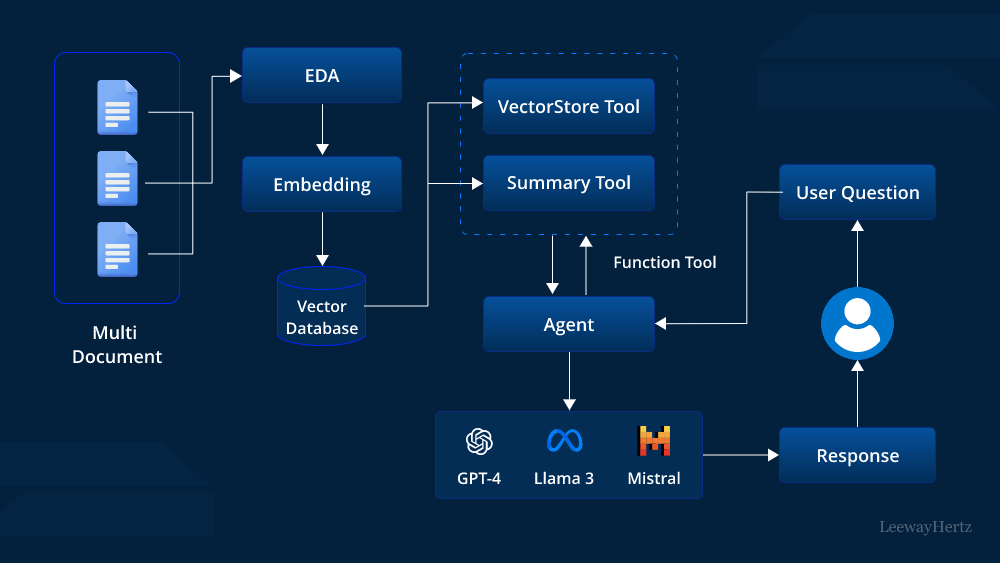
What is Agentic RAG?
Agentic RAG stands for Retrieval-Augmented Generation, a method that integrates retrieval mechanisms with generative models. The goal is to generate outputs that are not only coherent but also factually accurate and contextually relevant. This is achieved by retrieving relevant information from large databases or knowledge sources before generating responses, making the generated content more aligned with real-world data.
In traditional generative models, outputs are solely dependent on the data the model was trained on. This can sometimes lead to inaccuracies, especially when the training data is outdated or lacks specific information. Agentic RAG addresses this limitation by augmenting the generative process with real-time retrieval from external sources, thus improving the relevance and factuality of the output.
Types of Agentic RAG
Agentic RAG can be broadly categorized into two types:
- Fixed Retrieval-Augmented Generation: In this type, the retrieval mechanism is fixed and retrieves information from a pre-determined set of data sources. This is useful in scenarios where the information needs are predictable, such as FAQs or specific knowledge bases. The retrieval component is not adaptive and relies on static data, which can limit its ability to handle novel queries effectively.
- Dynamic Retrieval-Augmented Generation: Dynamic RAG involves a flexible retrieval mechanism that can adaptively select data sources based on the context of the query. This type allows the model to access a wider range of information, making it suitable for more complex or evolving queries. The dynamic approach is more sophisticated and can provide more nuanced and context-specific responses.
Applications of Agentic RAG
Agentic RAG has a wide range of applications across various industries, thanks to its ability to enhance the performance of generative models. Some of the key applications include:
- Customer Support: Agentic RAG can be used in customer support systems to provide accurate and timely responses to customer queries. By retrieving relevant information from knowledge bases, it ensures that the responses are not only contextually appropriate but also up-to-date, improving customer satisfaction and reducing the need for human intervention.
- Content Creation: In content creation, Agentic RAG can assist writers by generating relevant suggestions or drafts based on the latest data. This can be particularly useful in fields like news reporting or research, where up-to-date information is crucial. By integrating real-time data retrieval, content generated by these models is more likely to be factually correct and relevant.
- Personalized Recommendations: Agentic RAG can enhance recommendation systems by generating personalized suggestions that are informed by a user’s preferences and the latest available information. This approach is particularly beneficial in e-commerce, entertainment, and other sectors where personalization plays a key role in user engagement.
- Medical and Legal Advice: In fields such as medicine and law, where accuracy and relevance are critical, Agentic RAG can help professionals by providing information that is both current and reliable. For instance, in medical diagnostics, the system can retrieve the latest research findings and guidelines to assist healthcare providers in making informed decisions.
Implementing Agentic RAG
Implementing Agentic RAG involves several key steps, which ensure that the system effectively combines retrieval and generative capabilities. Here’s a simplified approach to implementing Agentic RAG:
- Data Source Selection: The first step in implementing Agentic RAG is to select appropriate data sources for retrieval. This can include databases, knowledge bases, or real-time data feeds. The choice of data sources will depend on the specific application and the type of information required.
- Retrieval Mechanism Development: Next, a retrieval mechanism is developed to fetch relevant information from the selected data sources. This mechanism needs to be robust and capable of handling various query types. For dynamic RAG, this step involves creating a system that can adaptively select the most relevant sources.
- Integration with Generative Model: The retrieved data is then integrated with the generative model. This can involve feeding the retrieved information directly into the model or using it to guide the generation process. The integration needs to be seamless to ensure that the generated outputs are coherent and relevant.
- Evaluation and Optimization: Finally, the system should be evaluated to ensure that it meets the desired performance standards. This involves testing the outputs for accuracy, relevance, and coherence. Continuous optimization is required to improve the model’s performance and adapt to new data sources or evolving requirements.
Conclusion
Agentic RAG is a powerful approach that significantly enhances the capabilities of generative AI models by incorporating retrieval-based mechanisms. By understanding its types, applications, and implementation, businesses can leverage Agentic RAG to create more accurate, relevant, and engaging AI-driven solutions. Whether in customer support, content creation, or personalized recommendations, the potential of Agentic RAG to transform how we interact with AI is immense and still expanding.
 Tech Business
Leave a comment