Understanding the role of artificial intelligence (AI) in Long-Term Value (LTV) models can transform how businesses strategize and make decisions. This article explores how AI is reshaping LTV models, enhancing customer relationships, and driving business success.
Introduction to AI and LTV Models
Long-Term Value (LTV) models are essential for businesses aiming to maximize customer value over time. These models predict the total revenue a customer will generate throughout their relationship with a company. Integrating artificial intelligence into LTV models can provide deeper insights, more accurate predictions, and more effective strategies for customer retention.
The Role of AI in Enhancing LTV Predictions
Artificial intelligence significantly improves the accuracy of LTV predictions. Traditional models often rely on historical data and simplistic algorithms, which can limit their effectiveness. AI, however, can analyze vast amounts of data from various sources, including purchase history, customer behavior, and interaction patterns. By using machine learning algorithms, AI can identify complex patterns and trends that are not apparent in conventional models.
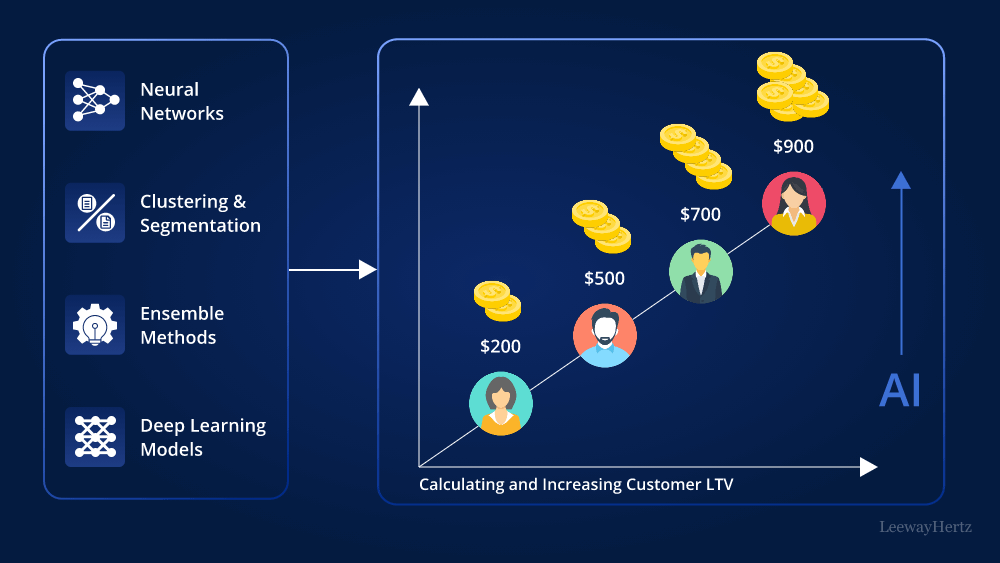
AI-driven LTV models use advanced techniques like regression analysis, clustering, and neural networks to enhance prediction accuracy. These methods enable businesses to forecast customer behavior more reliably and make data-driven decisions that optimize marketing and sales strategies.
Personalization and Customer Segmentation
One of the most valuable contributions of AI in LTV models is the ability to personalize customer interactions. AI can analyze individual customer data to create detailed profiles and segment customers into groups based on their behavior, preferences, and potential value. This segmentation allows businesses to tailor their marketing efforts and product offerings to meet the specific needs of each group.
For instance, AI can help identify high-value customers who are likely to generate substantial revenue over time. By focusing on these customers with targeted promotions and personalized offers, businesses can increase their chances of retaining them and maximizing their long-term value.
Improving Customer Retention with AI
Customer retention is a critical factor in maximizing LTV. AI plays a crucial role in identifying at-risk customers and developing strategies to retain them. By analyzing data on customer interactions, purchase patterns, and feedback, AI can predict which customers are likely to churn and why.
For example, AI can detect changes in purchasing behavior or a decline in engagement that may indicate dissatisfaction. With this information, businesses can implement proactive measures such as personalized incentives, improved customer support, or targeted communications to address the issues and enhance customer loyalty.
Optimizing Marketing Strategies with AI
AI in LTV models also enhances marketing strategies by providing insights into which channels and messages are most effective. By analyzing customer data, AI can determine the best times to reach out, the types of content that resonate most, and the optimal channels for communication.
This data-driven approach allows businesses to allocate marketing resources more efficiently and create campaigns that are more likely to generate positive responses. AI can also help measure the impact of marketing efforts on LTV, providing valuable feedback that can be used to refine and improve future strategies.
Leveraging Predictive Analytics
Predictive analytics, powered by AI, is another powerful tool in LTV models. By analyzing historical data and identifying trends, AI can forecast future customer behavior and revenue potential. This foresight allows businesses to make informed decisions about product development, pricing strategies, and customer engagement tactics.
Predictive analytics can also help businesses anticipate market changes and adapt their strategies accordingly. For example, if AI predicts a decline in customer spending, businesses can adjust their marketing efforts or offer special promotions to counteract the trend and maintain customer value.
Challenges and Considerations
While AI offers numerous benefits for LTV models, it is essential to address some challenges. Data quality and privacy are significant concerns. AI relies on accurate and comprehensive data to generate reliable predictions. Businesses must ensure that their data is clean, up-to-date, and compliant with privacy regulations.
Additionally, implementing AI in LTV models requires a level of expertise and investment in technology. Businesses need skilled professionals to develop and manage AI algorithms and systems effectively. Despite these challenges, the potential rewards of using AI in LTV models make it a worthwhile endeavor for many organizations.
Conclusion
Artificial intelligence is revolutionizing Long-Term Value (LTV) models by enhancing prediction accuracy, personalizing customer interactions, and optimizing marketing strategies. By leveraging AI, businesses can gain deeper insights into customer behavior, improve retention rates, and drive long-term success.
Integrating AI into LTV models is not without its challenges, but the benefits far outweigh the difficulties. As technology continues to advance, the role of AI in LTV models will only grow more significant, offering businesses new opportunities to maximize customer value and achieve sustained growth.
By understanding and harnessing the power of AI in LTV models, businesses can stay ahead of the competition and build stronger, more profitable customer relationships.
 Tech Business
Leave a comment