Artificial Intelligence (AI) has revolutionized many fields, and gaming is no exception. The integration of AI in gaming has transformed how games are developed, played, and experienced, leading to more immersive and dynamic interactions. This article explores the significant ways in which AI in gaming is reshaping the industry, enhancing gameplay, and creating more engaging experiences for players.
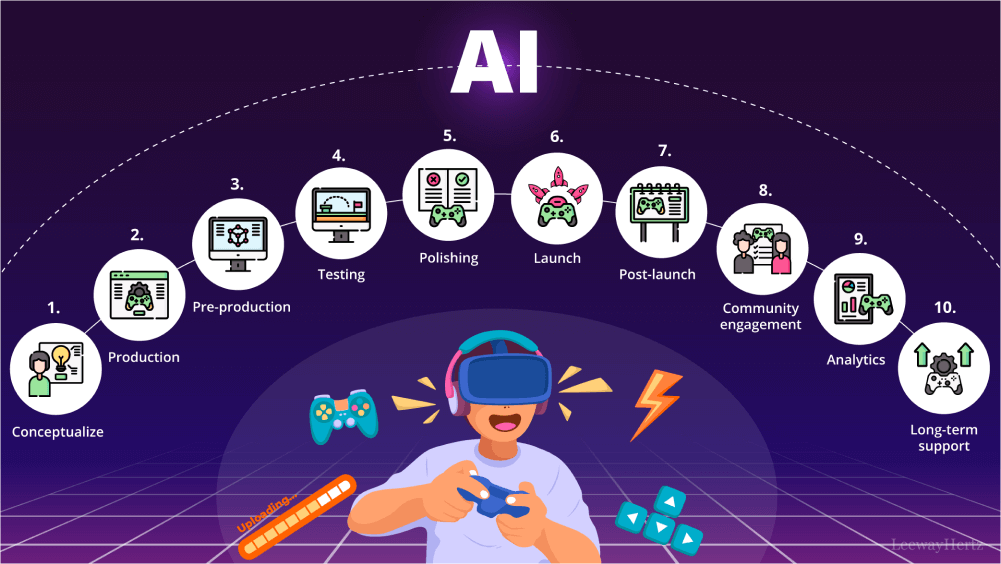
The Role of AI in Gaming
AI in gaming serves several critical functions, ranging from improving game design to enhancing player interaction. At its core, AI helps simulate intelligent behavior in non-player characters (NPCs), making them act more realistically. This allows for more challenging and engaging gameplay, as NPCs can react to player actions in a more lifelike manner.
Enhancing NPC Behavior
One of the most prominent applications of AI in gaming is the enhancement of NPC behavior. Traditionally, NPCs followed predictable patterns, making them easy to outsmart. However, with advanced AI algorithms, NPCs can now learn and adapt to player strategies. This leads to more unpredictable and challenging opponents, which increases the overall difficulty and enjoyment of the game.
For instance, AI can enable NPCs to adjust their tactics based on the player’s actions. If a player repeatedly uses a specific strategy, the AI can recognize this pattern and adapt its behavior to counter it. This not only makes the game more challenging but also encourages players to think creatively and strategize more effectively.
Procedural Content Generation
AI in gaming also plays a crucial role in procedural content generation. This technique involves using algorithms to automatically generate game content, such as levels, maps, and quests. By leveraging AI, developers can create vast and varied game worlds without manually designing every element. This not only saves time but also provides players with a more diverse and dynamic gaming experience.
For example, AI-driven procedural generation can create unique and expansive environments in open-world games. This ensures that each player’s experience is different, as the game world evolves and changes with each playthrough. It also allows for the creation of complex game worlds that would be challenging to design manually.
Personalizing Player Experiences
Another significant benefit of AI in gaming is its ability to personalize player experiences. AI algorithms can analyze player behavior and preferences to tailor game content and difficulty levels to individual players. This ensures that each player has a unique and engaging experience that matches their skill level and play style.
For instance, AI can adjust the difficulty of a game in real-time based on how well a player is performing. If a player is struggling, the AI can make the game easier by providing additional hints or reducing the difficulty of challenges. Conversely, if a player is excelling, the AI can introduce more complex obstacles to keep the game challenging and enjoyable.
AI-Driven Narrative and Storytelling
AI in gaming is also transforming narrative and storytelling. Traditionally, game narratives were linear and predetermined, but AI allows for more dynamic and interactive storytelling. AI-driven systems can create branching storylines and dialogue options that respond to player choices, leading to a more immersive and personalized experience.
This dynamic storytelling is particularly evident in role-playing games (RPGs) and other genres that focus on player choice and character development. AI can generate dialogue and storylines that reflect the player’s decisions, making the narrative feel more responsive and engaging. This level of interaction enhances player immersion and allows for more meaningful and personalized storytelling experiences.
Improving Game Testing and Quality Assurance
AI in gaming is also revolutionizing the game testing and quality assurance process. Traditionally, game testing was a labor-intensive process involving extensive manual playtesting to identify bugs and issues. AI can streamline this process by automating many aspects of testing, such as identifying glitches, performance issues, and balancing problems.
AI-driven testing tools can simulate a wide range of player behaviors and scenarios, allowing developers to identify and address potential issues more efficiently. This not only improves the overall quality of the game but also accelerates the development process, leading to faster releases and more polished final products.
Future Trends and Developments
As AI technology continues to advance, its role in gaming is expected to expand even further. Future developments may include more sophisticated AI algorithms capable of creating even more realistic and engaging game worlds. Additionally, AI could play a larger role in developing new genres and gameplay mechanics, pushing the boundaries of what is possible in gaming.
Conclusion
AI in gaming has already had a profound impact on the industry, enhancing NPC behavior, procedural content generation, personalization, storytelling, and quality assurance. As technology continues to evolve, AI’s role in gaming will likely become even more significant, leading to more immersive and dynamic gaming experiences. For both developers and players, the integration of AI in gaming promises a future full of exciting possibilities and innovations.
 Tech Business
Leave a comment