The rapid evolution of artificial intelligence (AI) is revolutionizing industries and reshaping the future. One of the key advancements contributing to this change is Automated Machine Learning, or AutoML. As the complexity of AI increases, the demand for tools that simplify and automate the machine learning process has risen, and AutoML is at the forefront of this transformation. In this article, we will explore how AutoML is transforming AI, making it more accessible, efficient, and scalable.
What is AutoML?
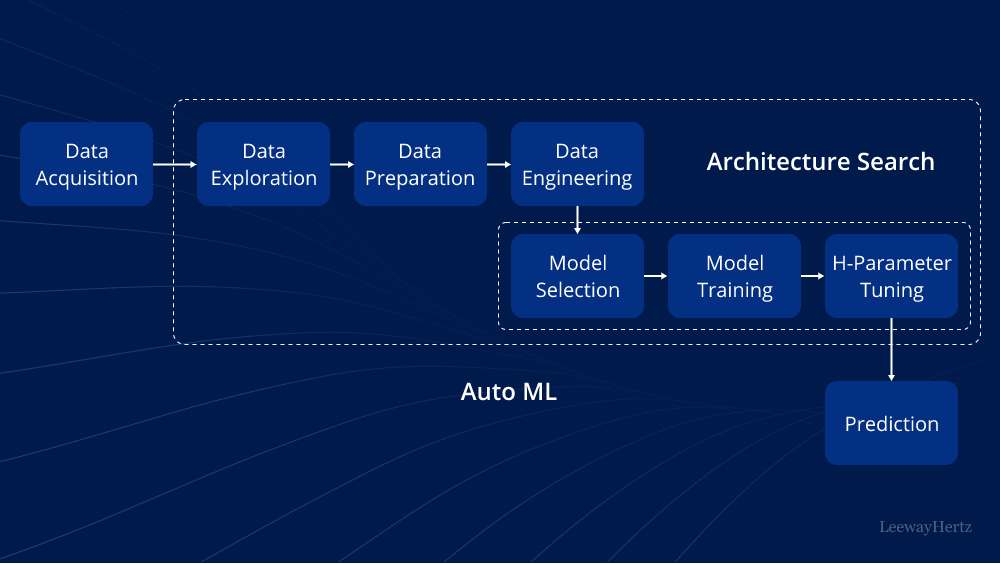
Before delving into how AutoML is transforming AI, it’s essential to understand what AutoML is. AutoML refers to the process of automating the end-to-end tasks of applying machine learning models to real-world problems. Traditionally, building AI models has required data scientists to perform tasks such as data preprocessing, feature engineering, model selection, and hyperparameter tuning manually. These tasks are often time-consuming, and they demand a high level of expertise.
AutoML automates these processes, allowing developers and non-experts alike to deploy machine learning models with minimal intervention. It leverages AI and algorithms to choose the best models, optimize parameters, and even assess model performance automatically.
Democratizing AI
One of the most profound ways in which AutoML is transforming AI is by democratizing access to advanced machine learning technologies. Traditionally, building and fine-tuning AI models required specialized knowledge in statistics, mathematics, and programming. This created a barrier for businesses and individuals who lacked the technical expertise to develop AI systems.
AutoML has lowered these barriers by providing a user-friendly interface that automates the entire workflow, from data preparation to model deployment. This democratization means that even users without a strong background in data science can now harness the power of AI. Small businesses, researchers, and non-technical users can integrate machine learning into their operations, unlocking new opportunities and innovation.
Reducing the Development Time of AI Models
Another crucial aspect of how AutoML is transforming AI is its ability to significantly reduce the time required to develop AI models. Traditional machine learning pipelines can take weeks or even months to complete. Each step, from collecting and cleaning data to testing various models and hyperparameters, requires meticulous effort.
AutoML automates much of this process, accelerating the timeline for deploying AI solutions. By eliminating the need for manual feature engineering and model tuning, AutoML allows AI projects to move from ideation to implementation at a fraction of the time. This reduction in development time translates to faster innovation cycles and quicker adaptation to changing market demands.
Enhancing Model Accuracy and Performance
When considering how AutoML is transforming AI, it’s important to look at the accuracy and performance improvements it brings to machine learning models. One of the core features of AutoML is its ability to automate model selection and optimization. It evaluates a wide range of algorithms, techniques, and hyperparameters to find the best-performing model for a given task.
Since AutoML tools have access to an array of machine learning algorithms and vast computational resources, they can often outperform models manually built by humans. Through sophisticated optimization techniques, AutoML ensures that models are not only accurate but also generalize well to unseen data. This results in AI systems that are more robust and reliable, especially when dealing with complex real-world problems.
Scaling AI Solutions Across Industries
As AutoML continues to evolve, it is playing a key role in scaling AI solutions across various industries. AutoML tools can be applied to a diverse range of use cases, from healthcare and finance to manufacturing and retail. Its flexibility in automating repetitive tasks allows businesses to implement AI without the need for large teams of data scientists.
For example, in healthcare, AutoML is transforming AI by enabling faster diagnosis through automated image analysis and predictive modeling. In finance, it is improving fraud detection systems by continuously learning from new data. In retail, AutoML is optimizing supply chain management by predicting demand fluctuations with greater accuracy. The potential applications are vast, and as AutoML becomes more refined, its impact will continue to grow across different sectors.
Lowering the Costs of AI Implementation
Another way in which AutoML is transforming AI is by reducing the costs associated with AI implementation. Traditionally, hiring expert data scientists and machine learning engineers is expensive. Furthermore, manually developing and fine-tuning AI models requires significant computational resources, which can be costly for small to medium-sized enterprises.
AutoML significantly lowers these costs by automating labor-intensive processes and reducing the need for human intervention. Businesses no longer need to hire large teams of data scientists to build machine learning models from scratch. Instead, AutoML platforms allow a smaller team or even a single individual to develop and deploy models efficiently. This cost reduction makes AI more accessible, even for organizations with limited budgets.
The Future of AI and AutoML
Looking forward, the impact of AutoML on AI development will only continue to grow. As machine learning models become more complex and data sets grow larger, AutoML will be essential for managing the increasing demand for AI-driven solutions. In the future, we can expect AutoML to further enhance its capabilities, with more advanced techniques like neural architecture search (NAS) being automated. These advances will push the boundaries of AI, enabling even more sophisticated models to be built with minimal human intervention.
Additionally, the future of AutoML may involve the development of domain-specific solutions. AutoML platforms could be tailored to address the unique challenges of industries like healthcare, finance, and education, further improving AI adoption in these sectors.
Conclusion
AutoML is undoubtedly transforming AI by making machine learning more accessible, efficient, and scalable. It simplifies the AI development process, reducing the need for extensive expertise while speeding up model development. As AutoML continues to evolve, its role in democratizing AI, improving model performance, and lowering costs will drive the next wave of AI innovation. By automating complex tasks, AutoML is paving the way for a future where AI is seamlessly integrated into every aspect of our lives.
 Tech Business
Leave a comment