Introduction
In today’s data-driven world, organizations generate vast amounts of data daily. However, with this wealth of information comes the challenge of identifying unusual patterns or anomalies that could indicate critical issues or opportunities. AI in anomaly detection has emerged as a powerful tool, enabling businesses to harness the potential of artificial intelligence to enhance their data analysis capabilities. This article explores the significance of AI in anomaly detection, its methodologies, applications, and the benefits it offers to various sectors.
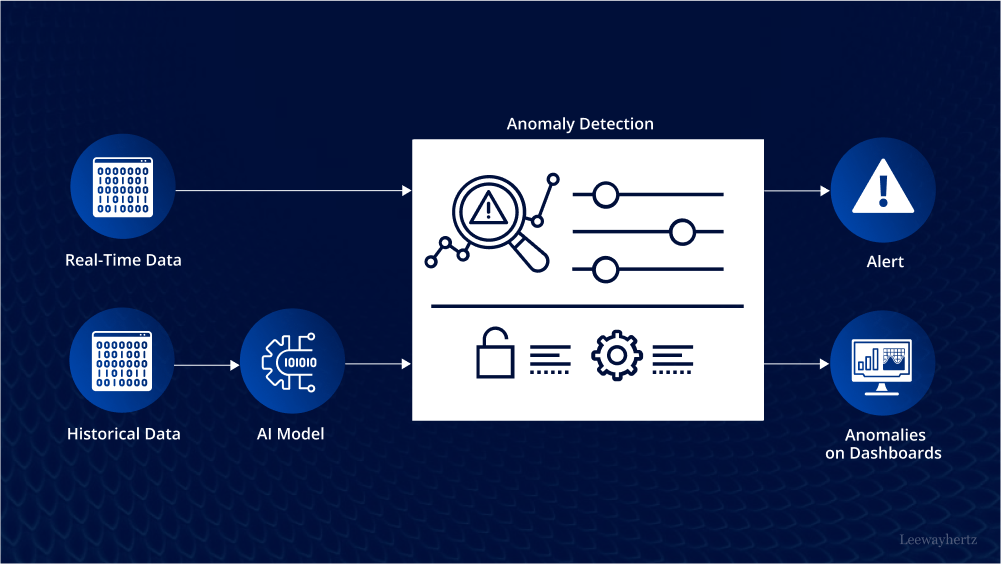
Understanding Anomaly Detection
Anomaly detection refers to the identification of patterns in data that do not conform to expected behavior. These outliers can indicate a range of issues, from fraud and security breaches to equipment malfunctions and data quality problems. Traditional statistical methods for anomaly detection often fall short due to their reliance on predefined thresholds and assumptions about data distribution. This is where AI in anomaly detection provides a more sophisticated and adaptable approach.
How AI Enhances Anomaly Detection
AI in anomaly detection leverages advanced algorithms, particularly machine learning and deep learning techniques, to analyze data sets in real time. Here are some key methodologies used:
Machine Learning Algorithms
Machine learning algorithms can learn from historical data and identify complex patterns. Techniques such as supervised learning, unsupervised learning, and semi-supervised learning are instrumental in training models to recognize anomalies. Supervised learning uses labeled data to train models, while unsupervised learning identifies anomalies without labeled data. Semi-supervised learning combines both approaches, enhancing the detection process.
Deep Learning Techniques
Deep learning, a subset of machine learning, uses neural networks to process vast amounts of data and uncover intricate patterns. With its ability to handle high-dimensional data, deep learning models excel in detecting anomalies in complex environments, such as image recognition and natural language processing. By employing architectures like convolutional neural networks (CNNs) and recurrent neural networks (RNNs), deep learning significantly improves the accuracy of anomaly detection.
Time-Series Analysis
Many industries rely on time-series data for monitoring performance and detecting anomalies over time. AI in anomaly detection can analyze temporal patterns and identify deviations from expected trends. Techniques such as Long Short-Term Memory (LSTM) networks, a type of RNN, are particularly effective in this context, enabling predictive modeling and anomaly detection in sequential data.
Applications of AI in Anomaly Detection
AI in anomaly detection finds applications across various sectors, significantly enhancing operational efficiency and security. Some notable areas include:
Financial Services
In the financial sector, AI algorithms help detect fraudulent transactions by analyzing patterns and flagging anomalies. By monitoring transaction data in real time, organizations can mitigate risks and reduce financial losses associated with fraud.
Healthcare
Healthcare providers leverage AI in anomaly detection to identify unusual patterns in patient data, which can signal potential health risks. Early detection of anomalies in vital signs or medical imaging can lead to timely interventions, improving patient outcomes and optimizing resource allocation.
Manufacturing
In manufacturing, AI techniques monitor equipment performance and detect anomalies in machinery operation. Predictive maintenance driven by AI can identify potential failures before they occur, minimizing downtime and reducing maintenance costs.
Cybersecurity
Cybersecurity is another critical area where AI in anomaly detection plays a pivotal role. By analyzing network traffic and user behavior, AI can identify unusual activities that may indicate security breaches, enabling organizations to respond swiftly to potential threats.
Benefits of AI in Anomaly Detection
The integration of AI in anomaly detection offers numerous advantages, including:
Enhanced Accuracy
AI algorithms continuously learn and adapt, resulting in improved accuracy in identifying anomalies. This reduces false positives and ensures that genuine anomalies are promptly detected.
Real-Time Processing
AI enables real-time data analysis, allowing organizations to identify and respond to anomalies as they occur. This timely detection is crucial for preventing potential damage and ensuring operational continuity.
Scalability
AI solutions can process vast amounts of data quickly, making them scalable for organizations of all sizes. As data volumes grow, AI in anomaly detection can effectively manage increased workloads without sacrificing performance.
Cost-Effectiveness
By automating the anomaly detection process, organizations can reduce the need for manual analysis, saving time and resources. The early identification of anomalies also minimizes potential losses, contributing to overall cost savings.
Challenges and Considerations
While AI in anomaly detection presents significant opportunities, it is not without challenges. Data quality, privacy concerns, and the need for domain expertise are critical considerations. Organizations must ensure that their data is clean and representative to train effective models. Additionally, addressing privacy issues related to data handling and ensuring compliance with regulations is essential.
Conclusion
AI in anomaly detection is revolutionizing how organizations interpret data and respond to potential issues. By employing advanced algorithms and methodologies, businesses can enhance their anomaly detection capabilities, leading to improved operational efficiency and risk management. As the technology continues to evolve, the role of AI in anomaly detection will undoubtedly grow, providing organizations with invaluable insights and a competitive edge in their respective industries. Embracing this technology will be vital for those looking to navigate the complexities of data in the modern world.
 Tech Business
Leave a comment