Introduction
Generative AI in healthcare is revolutionizing how medical professionals approach patient care, diagnostics, and treatment planning. By leveraging advanced algorithms and vast datasets, generative AI is creating new opportunities to enhance patient outcomes, streamline workflows, and support healthcare professionals in their decision-making processes. This article delves into the various applications of generative AI in healthcare and its implications for the future of the industry.
Understanding Generative AI
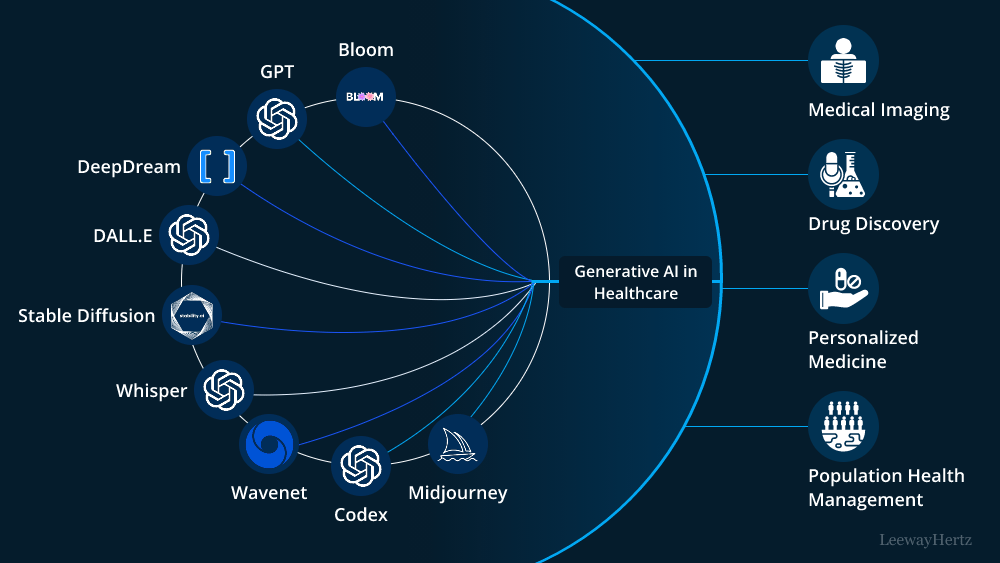
Generative AI refers to a class of artificial intelligence systems that can generate new content based on existing data. Unlike traditional AI, which often focuses on classification and prediction, generative AI creates new instances, making it particularly useful in fields that require innovation and creativity. In healthcare, generative AI can synthesize new medical data, generate medical images, and even assist in drug discovery.
Enhancing Diagnostics with Generative AI
One of the most promising applications of generative AI in healthcare is in diagnostics. By analyzing large datasets of medical images, generative AI can identify patterns and anomalies that may be missed by the human eye. For instance, in radiology, generative AI can help radiologists detect tumors or other abnormalities in X-rays, MRIs, and CT scans more accurately and efficiently.
Generative AI can also create synthetic medical images to augment training datasets. This can be particularly beneficial in scenarios where data is scarce or imbalanced. By generating diverse and realistic images, healthcare providers can train their algorithms to recognize a wider range of conditions, ultimately improving diagnostic accuracy.
Personalized Treatment Plans
Generative AI in healthcare also plays a vital role in developing personalized treatment plans. By analyzing patient data, including genetic information, medical history, and lifestyle factors, generative AI can help healthcare providers tailor treatments to individual patients. This approach not only increases the likelihood of treatment success but also minimizes potential side effects by avoiding a one-size-fits-all approach.
For instance, generative AI can predict how a patient might respond to a specific medication based on their unique genetic makeup. This capability enables healthcare professionals to select the most effective treatments, enhancing patient care and outcomes.
Drug Discovery and Development
The drug discovery process is often long, expensive, and fraught with challenges. Generative AI is transforming this process by enabling researchers to identify potential drug candidates more efficiently. By analyzing existing drug data and understanding the molecular structures of compounds, generative AI can suggest new drug formulations that might be effective against specific diseases.
Moreover, generative AI can simulate how these new compounds will interact with biological systems, allowing researchers to prioritize the most promising candidates for further testing. This not only accelerates the drug development process but also reduces costs, making it easier to bring new treatments to market.
Streamlining Administrative Tasks
In addition to its clinical applications, generative AI in healthcare is also streamlining administrative tasks. Healthcare organizations are often burdened with paperwork, billing, and scheduling, which can take valuable time away from patient care. Generative AI can automate many of these processes, allowing healthcare professionals to focus more on their patients.
For example, generative AI can assist in coding medical records and generating reports based on patient interactions. This automation reduces the likelihood of errors and ensures that healthcare providers are compliant with regulations. Furthermore, by optimizing scheduling and resource allocation, generative AI can improve the overall efficiency of healthcare facilities.
Improving Patient Engagement
Generative AI also has the potential to enhance patient engagement by providing personalized communication and support. For example, AI-powered chatbots can assist patients with scheduling appointments, answering common questions, and providing information about treatment options. These tools can make healthcare more accessible and ensure that patients receive timely information.
Moreover, generative AI can analyze patient feedback and preferences, allowing healthcare providers to tailor their communication strategies. By understanding patient needs better, healthcare professionals can foster stronger relationships and improve patient satisfaction.
Ethical Considerations and Challenges
While generative AI in healthcare holds great promise, it also raises ethical considerations and challenges that must be addressed. Issues related to data privacy, algorithmic bias, and transparency are critical when implementing AI solutions in healthcare settings. Ensuring that patient data is used responsibly and ethically is paramount to maintaining trust between healthcare providers and patients.
Furthermore, healthcare professionals must be adequately trained to work alongside AI technologies. Integrating generative AI into existing workflows requires a cultural shift within organizations, ensuring that healthcare providers understand the benefits and limitations of these tools.
Conclusion
Generative AI in healthcare is paving the way for innovative solutions that enhance patient care, streamline operations, and improve treatment outcomes. From diagnostics and personalized medicine to drug discovery and administrative efficiency, the potential applications are vast. As the healthcare industry continues to embrace generative AI, it is essential to address the ethical challenges and ensure that these technologies are implemented responsibly. The future of healthcare is bright, with generative AI leading the charge toward a more efficient, effective, and patient-centered approach.
 Tech Business
Leave a comment