Artificial Intelligence (AI) is revolutionizing industries around the globe, driving efficiency, improving decision-making, and creating new opportunities. This article explores AI use cases and applications across major industries, showcasing how AI is reshaping the way businesses operate. From healthcare to finance, manufacturing to retail, AI’s transformative potential is unlocking unprecedented value.
1. Healthcare: Enhancing Patient Care and Operational Efficiency
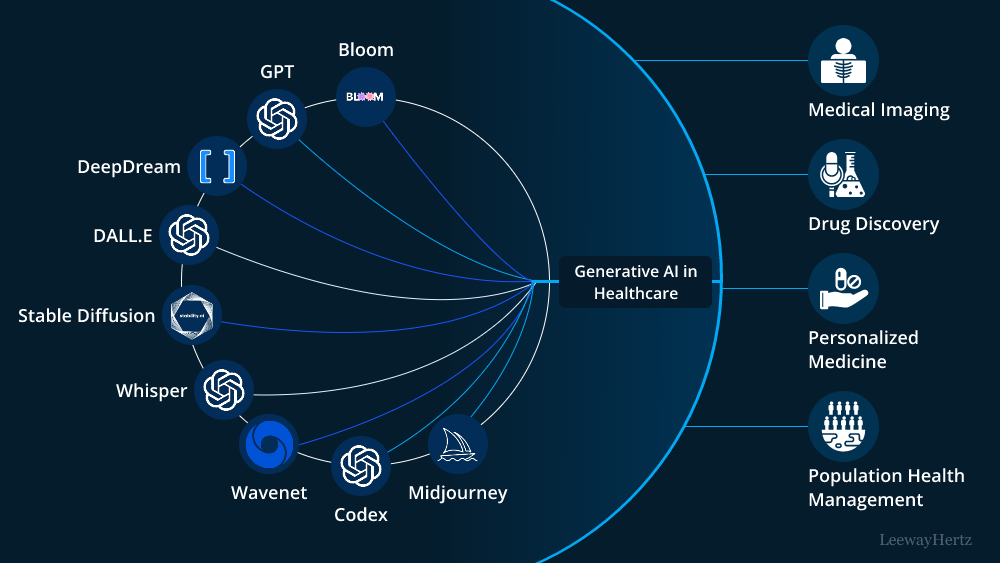
AI is making significant strides in the healthcare industry, with applications that improve patient care, streamline operations, and support medical research. One prominent AI use case in healthcare is in diagnostic imaging. AI-powered algorithms can analyze medical images such as X-rays, MRIs, and CT scans with remarkable accuracy, often detecting abnormalities that might be missed by human eyes. This speeds up diagnosis and allows for earlier intervention, improving patient outcomes.
Another critical application is predictive analytics in patient care. AI can analyze patient data to predict the likelihood of complications or readmissions, allowing healthcare providers to take proactive measures. Furthermore, AI-driven chatbots and virtual assistants are enhancing patient engagement by providing 24/7 support, answering questions, and scheduling appointments.
2. Finance: Revolutionizing Financial Services
The finance industry is leveraging AI to enhance customer service, detect fraud, and automate trading. AI use cases in finance include robo-advisors, which provide automated, algorithm-driven financial planning services with little to no human supervision. These platforms use AI to offer personalized investment advice, manage portfolios, and even execute trades on behalf of clients.
AI’s role in fraud detection is another game-changer for the finance sector. Machine learning algorithms can analyze vast amounts of transaction data in real-time, identifying patterns that signal fraudulent activity. This allows financial institutions to respond swiftly to potential threats, minimizing losses and enhancing security.
Moreover, AI-powered chatbots are being used by banks and financial institutions to improve customer service, answering queries, processing transactions, and providing financial advice, all while reducing operational costs.
3. Manufacturing: Optimizing Production and Maintenance
In manufacturing, AI is driving innovation through automation, predictive maintenance, and quality control. AI use cases in manufacturing include the deployment of robots and cobots (collaborative robots) that work alongside human workers, performing repetitive or dangerous tasks with high precision. This not only enhances productivity but also improves worker safety.
Predictive maintenance is another significant application, where AI algorithms analyze data from machinery sensors to predict equipment failures before they occur. This allows manufacturers to perform maintenance proactively, reducing downtime and maintenance costs.
Quality control is being revolutionized by AI-powered vision systems that inspect products for defects with a level of accuracy and speed unattainable by human inspectors. This ensures higher quality products, reduces waste, and enhances customer satisfaction.
4. Retail: Personalizing Customer Experiences
The retail industry is utilizing AI to provide personalized customer experiences, optimize inventory management, and enhance supply chain efficiency. AI use cases in retail include personalized recommendations, where machine learning algorithms analyze customer behavior and preferences to suggest products that are most likely to interest them. This not only improves the shopping experience but also boosts sales and customer loyalty.
Inventory management is another area where AI is making an impact. AI algorithms can predict demand for products based on historical data, market trends, and external factors, helping retailers maintain optimal stock levels, reduce excess inventory, and minimize stockouts.
AI-driven chatbots and virtual assistants are also being used in retail to provide 24/7 customer support, answer questions, guide users through purchases, and even handle returns, enhancing the overall customer experience.
5. Transportation: Driving Efficiency and Safety
AI is transforming the transportation industry by improving logistics, enhancing safety, and paving the way for autonomous vehicles. AI use cases in transportation include route optimization, where algorithms analyze traffic data, weather conditions, and other variables to determine the most efficient routes for deliveries. This reduces fuel consumption, lowers costs, and improves delivery times.
Autonomous vehicles represent a futuristic yet increasingly feasible application of AI in transportation. Self-driving cars and trucks use AI to navigate roads, avoid obstacles, and make decisions in real-time, potentially reducing the risk of human error and accidents.
AI is also enhancing safety in aviation, with AI-powered systems that monitor aircraft performance, predict maintenance needs, and assist pilots in decision-making during flights.
6. Education: Personalizing Learning and Administrative Efficiency
In education, AI is being used to personalize learning experiences, streamline administrative tasks, and enhance student engagement. AI use cases in education include adaptive learning platforms that tailor educational content to the needs of individual students, ensuring they receive the right level of challenge and support.
AI-driven chatbots and virtual assistants are also being used in educational institutions to provide student support, answer queries, and assist with administrative tasks such as enrollment and scheduling.
Furthermore, AI is helping educators analyze student performance data to identify learning gaps and provide targeted interventions, ultimately improving student outcomes.
Conclusion
AI use cases and applications across major industries are driving unprecedented changes, enhancing efficiency, and opening new avenues for growth and innovation. As AI technology continues to evolve, its impact will only deepen, reshaping the future of industries worldwide. Embracing AI is no longer a choice but a necessity for businesses that want to stay competitive and thrive in the modern economy.
 Tech Business
Leave a comment